
Farmington City Directory Shelf
The local collection picture is specific but incomplete. The verified digitized Farmington volume is a Central Telephone Company issue, not a continuous run of municipal directories. Minnesota Historical Society and Dakota County Historical Society resources provide ways to identify or request additional material, while Dakota County Library supplies research databases, microfilm equipment, and interlibrary loan. Ask staff for an exact city, year, and title before assuming a volume exists.
| Farmington collection | Verified coverage | Research location | What access provides |
|---|---|---|---|
| Central Telephone Directory | July 1945, Central Telephone Company | Dakota County Historical Society digitized PDF | Free subscriber, phone, residence, and business entries |
| Telephone-directory finding aid | County, city, and year inventory rows; exact Farmington run not extracted | Minnesota Historical Society finding aid | Route to the correct shelf or microfiche question |
| City and telephone directory search | Staff search for one name or business in up to five years | MNHS Gale Family Library | Requested scans by digital email |
| Local historical records | Collection-specific, with no complete Farmington directory run verified | Dakota County Historical Society | Mediated archive research and record-category help |
| Books and microfilm | Title-dependent | Dakota County Library and MNLINK | Loan request or reader and printer access |
That mix is why a Farmington city directory search should be documented by volume and date. The absence of an online title is not proof that a historical collection never existed, and a catalog route is not proof of a particular year.
Farmington's 1945 Telephone Directory
The actual digitized local source is the Central Telephone Company directory from July 1945. It has Farmington exchange pages and alphabetical listings for the Farmington and Castle Rock area. Entries can include a person or business name, “res” notation, a phone or exchange number, and occasional street or location language. For example, the volume lists City Hall as 197-2, the depot as 240, and Steele Furniture & Funeral Service as 196. Those examples are reported as they appear in that historical telephone book.
Dakota County Library's genealogy and local-history research categories provide the broader research setting for a Farmington city directory entry and its companion sources.
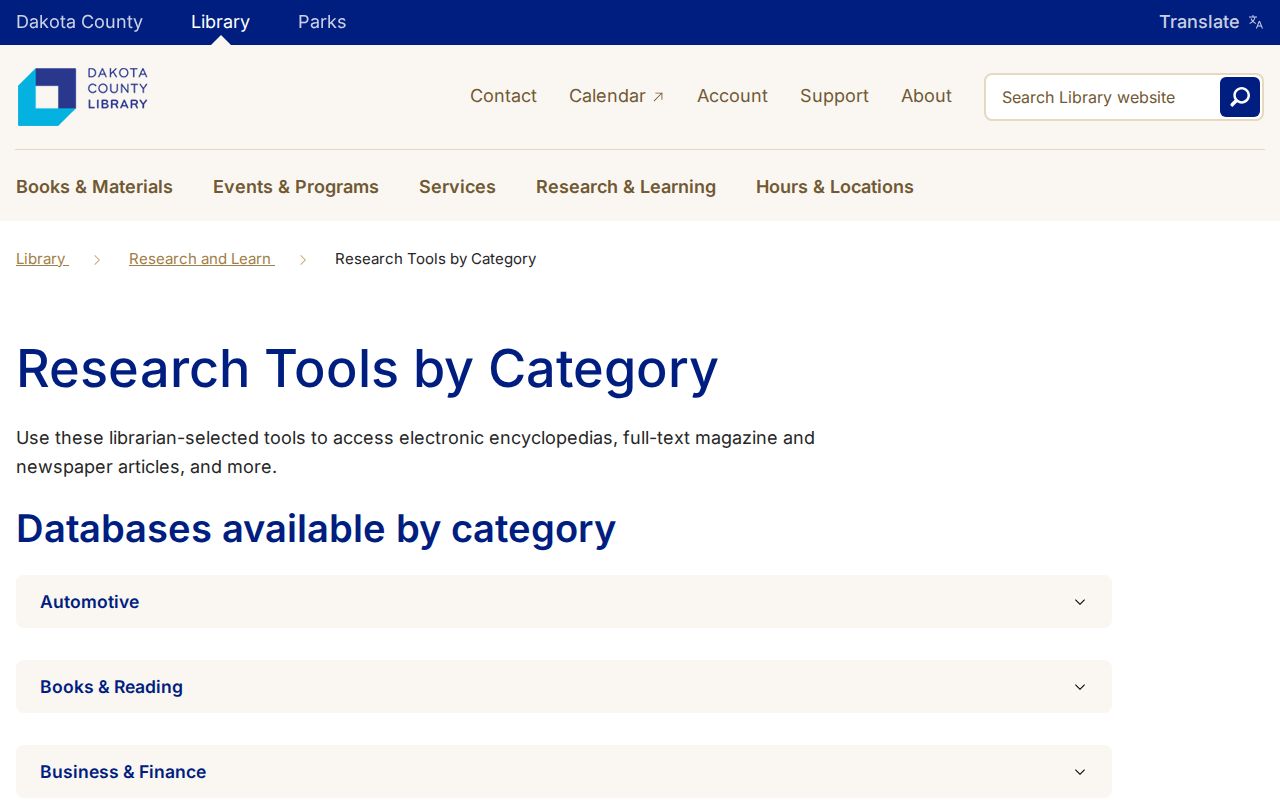
Library databases and staff routes can connect a subscriber clue to census, newspaper, family-history, or digitized-document research without representing the telephone volume as a complete list.
The 1945 book establishes subscriber or business contact at that moment. It does not establish legal residence, ownership, continued presence, or every person at an address. Preserve its initials, punctuation, and abbreviations before looking for the same name elsewhere.
Read a Farmington City Directory Entry
Read the scanned page, not just a remembered spelling. The verified 1945 telephone volume uses conventions that differ from a modern address database. Initials, “res,” exchange numbers, business headings, and local-town labels all carry context. Its entries do not supply modern parcel or case numbers, a date of birth, an ownership flag, or a guarantee that a listed household includes every person connected to that location.
| Name or heading | A subscriber name, a business name, or an alphabetical entry label. |
|---|---|
| “res” | A residence notation used in the volume. Keep it with the transcription rather than expanding it into a claim of legal residence. |
| Phone or exchange number | A historical contact clue that can be compared with nearby names, notices, and the original page. |
| Location language | An occasional street, farm, town, or business reference, not a standardized modern address field. |
| PDF page | The image location needed to revisit a reading or compare a spelling. |
- Criss-cross directory
- An address-ordered directory that can point from an address to a subscriber. A verified Farmington title and year have not been located.
- Householder index
- An index arranged around a household reference rather than a complete population list. Its presence must be checked in the actual volume.
- Abbreviation key
- The publisher's explanation of shorthand. Photograph or transcribe it when the volume includes one, because conventions vary by publisher and year.
Trace a Farmington City Directory Household
A careful household trace moves between sources rather than treating an entry as a verdict. Begin with the exact spelling and notation in the 1945 directory or with a current legal address. Each next step should preserve the date, source, and uncertainty. A disappearance from a telephone list can reflect a move, a death, an unlisted number, a changed name, or a simple coverage gap.
- Transcribe the name, initials, “res” notation, phone or exchange number, business wording, and PDF page exactly as printed.
- Compare that lead with the nearest available federal census, including 1940 or 1950, and with the verified Minnesota state-census years where they fit the era.
- Use a parcel's legal description for deed or plat research if an address needs to be tied to land records. Keep a subscriber entry separate from a property conclusion.
- Search library, DCHS, or MNHS newspaper and obituary routes for notices that can supply a date, family connection, or former Farmington reference.
- Ask staff whether an address-ordered or reverse volume exists for the year needed before treating an address as a subscriber index.
This workflow favors original sources and makes a useful audit trail for genealogy, estate questions, or local-history research.
Pair Farmington Directories With Census Years
Minnesota state censuses are verified for 1857, 1865, 1875, 1885, 1895 with partial holdings, and 1905. Federal census releases follow the current 72-year rule, with 1950 the latest released census in 2026. These sources can show household names, ages, relationships, and residence-era context, but neither is an annual directory and boundaries can change.
Use a telephone entry as a time-specific starting point, then check census timing on both sides of it where available. Compare names and location descriptions without forcing an exact street match. Farmington's historical geography, annexations, and incomplete subscription coverage make a legal description, neighboring parcel, or newspaper item valuable corroboration.
Request Farmington Directory Years
When a desired Farmington city directory is not online, the access path is known even when the exact year run is not. MNHS Gale Family Library offers a city-directory search for $10, a telephone-directory search for $10, or both for $20. The fee includes $5 processing, scans can be sent by digital email, and the normal estimate is three to four weeks, with up to twelve weeks possible.
Dakota County Historical Society has more than half a million church, cemetery, census, obituary, marriage, Catholic, World War I biography, and 1918-registration records. Its research service is a $15-per-half-hour donation. Dakota County Library's MNLINK interlibrary loan can request books and microfilm not held locally, allows up to twelve active requests, and most requests are filled in roughly thirty days. Farmington, Burnhaven, Pleasant Hill, and Wescott have system microfilm readers and printers.
For a broader name or place search, Ancestry Library Edition is available in-library, while HeritageQuest supplies federal census, local histories, family trees, digitized books, and some vital or historical material. Minnesota Reflections adds digitized images and documents from Minnesota historical societies, libraries, archives, and universities. Use each database as a lead and verify the original record.
MNHS directory-search request details explain the paid staff-search route, while Dakota County Historical Society's records search identifies the local archive categories. Ask for the exact city and year in every request.
Farmington Reverse Directory Limits
Address-to-subscriber research requires a reverse or criss-cross directory, and no verified Farmington title or year was found in the official sources reviewed. The July 1945 directory is a direct subscriber source. It should not be described as an address-ordered book. Library, MNHS, DCHS, and interlibrary-loan staff are the appropriate routes for confirming a specific reverse volume.
Even an identified reverse volume would be limited to its own publisher, subscribers, date, and indexing practice. It would not fill every household gap, settle ownership, or establish a modern connection. Record the title and year before relying on an address result.
Farmington Newspaper and Archive Routes
Newspaper and archive material can supply the narrative between a directory entry and later records. Dakota County Library lists Historical Minneapolis Tribune coverage from 1867 through 1922, Star Tribune text from 1986 to the present, St. Paul Pioneer Press text from 1988 to the present, plus America’s News and Minnesota News Sources. Access terms vary by library card, database, or in-library use.
The Dakota County historical record groups identified by MNHS include District Court business-name registers from 1911 through 1978, naturalization records, probate minutes and will books, coroner records, tax judgment books, and Farmington ordinance or clipping collections. DCHS adds mediated obituary and local-record searching. These are supporting evidence routes, not substitutes for reading the original directory page.
Place a Farmington Address in 1885
The Library of Congress holds a September 1885 Farmington Sanborn map, one sheet issued by the Sanborn Map Company. It can show building outlines, materials, height or function, windows and doors, water mains and hydrants, plus street, house, and block numbers. That makes it useful for understanding an old downtown address or the built setting around a location.
The Library of Congress Farmington Sanborn sheet is an environmental and address-context source. It has no occupant names, and its one-sheet scope should not be expanded into a complete city map or a directory substitute.
Farmington Library History in the Record Trail
Farmington's library history adds a local reminder that collections move. A Dakota County Historical Society newsletter story reports that the Farmington library association formed on June 8, 1871. It later occupied a tin shop, the Elm and Third area, the Sanford Hospital basement, and City Hall. A directory or newspaper lead may therefore point toward more than one institution or storage setting over time.
That history does not establish a particular book's location or a person's identity. It does explain why the practical research path crosses the Farmington library system, DCHS, MNHS, and digitized sources instead of relying on one continuous shelf of city directories.